We live in a time where speed is celebrated, where convenience often replaces connection, and where self-preservation can sometimes take priority over compassion. The world is loud, busy, and, at times, unkind. And yet — there is still a quiet power in choosing to care.
Be the one who chooses love over indifference. Be the one who shows up, even when it’s inconvenient. Be the one who makes the effort to check in, to ask the questions that matter, and to truly listen to the answers.
There is something rare and extraordinary about a person who loves without hesitation — who allows themselves to feel without apologizing for the depth of their heart. In a world that teaches us to “play it cool” and hide our vulnerabilities, being open and real is an act of courage.
The Strength in Softness
It’s easy to mistake softness for weakness, but in truth, it is one of the strongest qualities a human being can possess. Remaining kind in the face of cruelty, keeping your heart open when life has tried to close it — that takes grit.
Believe in the gentleness that still exists, even if it feels hidden. Believe in the goodness of people, even when the news paints a darker picture. Believe in the beauty of being untethered, of moving through life with trust instead of fear.
Softness is not about being naive. It’s about being grounded in hope. It’s about refusing to let bitterness take root in your soul.
Choosing to Show Up
Showing up doesn’t always mean grand gestures. Sometimes it’s the simple things — answering the phone when a friend calls late at night, offering a smile to a stranger, sending a thoughtful message without expecting anything in return.
When you make someone feel seen, you give them a gift that stays with them far longer than you realize. When you show up, you remind others that they matter — and sometimes, that reminder can change the course of someone’s day… or even their life.
A World in Need of More Gentle-Hearted Souls
The truth is, the world doesn’t need more carelessness. It doesn’t need more disregard, more people hardened by cynicism. What it needs are those who choose to remain tender, who keep their compassion alive even after being hurt.
I will not trade the garden blooming in my heart for the weight of cold stones. The world may be harsh, yes, but that hardness only means it is in desperate need of those who dare to keep their hearts in full bloom — people willing to plant kindness in barren places, again and again.
In the end, caring is not a weakness. It is a quiet rebellion against the apathy that threatens to spread. So, be the one who loves. Be the one who listens. Be the one who shows up.
Because when we choose to keep our hearts blooming, even in the roughest of seasons, we become the very thing the world needs most.
Somewhere along the road of growing older, I’ve started asking a different kind of question—not about achieving more or standing out, but about what it means to simply be.
There was a time when I equated meaning with success. With visibility. With being someone others recognized or admired. But these days, in the soft hush of early mornings or the long pause before sleep, I ask myself something else entirely:
Can a life be deeply meaningful even if it’s not exceptional by the world’s standards?
This question doesn’t come from sadness. It comes from curiosity. It’s the kind of question that stirs quietly in the soul—not loud or dramatic, just honest.
I no longer chase urgency. Some mornings, there’s no plan at all. No project waiting. No title to uphold. So, I sit. I breathe. I listen. Not to the world clamoring outside, but to the subtle rhythm within: the slow rise of breath, the quiet heartbeat, the pulse of simply existing.
I think often of the words of Alan Watts, who once wrote: “The meaning of life is just to be alive. It is so plain and so obvious and so simple. And yet, everybody rushes around in a great panic as if it were necessary to achieve something beyond themselves.”
That line lands differently the older I get. It’s not a call to do less. It’s an invitation to see more—to notice the sacredness hidden in the ordinary, the beauty of just being here.
I’ve lived a life of genuine effort. I’ve been a filmmaker, a teacher, a musician, a nonprofit worker. My days were full of purpose, but they didn’t come with headlines or honors. Still, something inside kept whispering, “It’s not enough. You could’ve done more.”
That whisper wasn’t mine alone. It was inherited—from a culture that prizes greatness over goodness, performance over presence, visibility over sincerity.
Even in my younger years, I remember wanting to be seen. Not for fame, but for validation. I had dreams, questions, a yearning for connection—but rarely felt invited to share them. I wasn’t excluded, just overlooked. And so I learned to measure value by recognition. If no one asked, maybe it didn’t matter. If I wasn’t extraordinary, maybe I wasn’t enough.
These quiet injuries shape us. They drive us to overextend, to seek affirmation outside ourselves, to confuse being noticed with being worthy.
But now I understand—I was never failing. I was simply living a different kind of life. A sincere life. A quiet, faithful walk through the world that doesn’t always show up on resumes or in applause.
And that realization shifted everything.
Because this isn’t only about personal healing—it’s about cultural remembering.
In many parts of modern life, especially in the West, aging is treated like a slow vanishing. Youth is glamorized. Speed is celebrated. Noise is rewarded. We speak of honoring elders, but too often we forget to listen to them. The wisdom of lived experience is brushed aside for the flash of the new.
But not every culture has forgotten.
In many Indigenous communities, elders are the memory-keepers. The ones who hold the stories, the rhythms, the guidance passed down through seasons of being. The Stoics believed that wisdom—not fame—was the highest virtue. In ancient tribes and forgotten villages, older voices still guide the path forward, not because they shout, but because they’ve learned to listen first.
What kind of culture forgets the value of its elders? What kind of system discards a deeply lived life simply because it doesn’t perform anymore?
I don’t want to answer that question with frustration. I want to live the alternative. If the world forgets to see aging as deepening, then I will choose to see it that way—for myself and for others.
In recent years, I’ve found comfort in Buddhist teachings. Not as dogma, but as a gentle rhythm. The Four Noble Truths helped me name a suffering I never quite understood: the craving to be other than I am. That craving once wore the mask of ambition, perfection, and productivity. But I now see it for what it was: a distraction from presence.
The invitation of the Buddhist path isn’t to achieve. It’s to return. Return to presence. To enoughness. To the gentle breath of now.
Letting go of the need to be exceptional doesn’t mean giving up. It means softening into what’s real. It means asking: What happens if I live this moment fully, even if no one applauds?
Carl Jung once said that his prescription for most patients was simple: walk every day and write things down. I’ve taken that to heart. Writing has become my way of listening inward. I don’t write for fame. I write to find clarity. To feel the quiet pulse of truth beneath my experiences. Even if no one reads the words, they’ve already done their work in me.
I no longer wait for someone to offer me a platform. I’ve stopped hoping to be chosen. Instead, I live as if what I carry matters—because it does.
Even now, doubts visit me. Did I make enough of this life? Did I leave a mark? But I’ve learned not to fear those questions. I welcome them like old friends. And I respond, softly:
Yes. It matters. Because I lived it with heart. Because I stayed true to what called me. Because I kept showing up—even when no one was looking.
That, to me, is enough.
Perhaps we were never meant to be exceptional. Perhaps we were meant to be present. To live with care. To offer kindness. To pass along something quieter than legacy but more enduring than fame: presence, attention, love.
Ernest Hemingway once wrote, “In our darkest hours, we don’t need advice.” And he was right.
When the weight of the world crashes down on us, advice can often feel like noise. Words, even if well-intentioned, can miss the mark when our hearts are aching. What we truly long for in those moments isn’t someone to tell us what to do—it’s someone who chooses to stay close while we try to find our way through.
We need connection. Stillness. A calm presence that gently says, “I’m here.”
A quiet act of love can speak volumes—more than any solution or suggestion ever could.
A Story of Silent Strength
I remember a time when my friend Sarah lost her younger brother unexpectedly in a tragic accident. The news came like a thunderclap—no warning, no explanation, just a harsh and painful silence that settled over her life like a fog. For the first few days, Sarah didn’t want to talk to anyone. She wasn’t looking for answers; she didn’t want motivational words or even religious comforts. She just wanted to grieve.
Her phone buzzed constantly with people offering condolences, advice, or attempts to cheer her up. Many meant well, but their messages felt distant—mechanical, even. What she needed wasn’t a flood of words. She needed something else entirely.
One evening, I decided to visit her. I didn’t bring flowers or a card. I didn’t rehearse what I would say. I just went.
When I arrived, she opened the door slowly. Her face was tired, swollen from crying. We didn’t say much. I sat beside her on the couch. We drank tea in silence. We watched the flicker of the candlelight on the table. We just sat.
Every now and then, she would whisper a thought—a memory, a feeling, a piece of pain—and I would nod. I didn’t interrupt. I didn’t try to soften her grief with optimism. I let her have her sadness.
Hours passed like that.
Before I left, she squeezed my hand and said quietly, “Thank you for not trying to fix it.”
That moment taught me something I’ve never forgotten: sometimes, the most powerful way to show up for someone is to simply be there.
The Power of Human Presence
When people are hurting, they don’t always need advice. They don’t want to be analyzed or “solved.” They just want to feel seen. Heard. Accepted in their pain.
Whether it’s a grieving parent, a friend going through a breakup, or a colleague battling burnout, your silent support can be a lifeline. Your presence says:
“You’re not alone.”
“You don’t need to pretend to be okay right now.”
“I’m not here to fix you—I’m here to be with you.”
That is love in its purest form.
Let’s Be That Presence for One Another
In a world obsessed with doing, fixing, and achieving, let’s remember that sometimes the most healing thing we can offer is not advice—but presence.
We don’t have to have the right words. We don’t need to come armed with solutions. We just need to show up, stay, and let love speak through our actions.
When someone you care about is in pain, don’t rush to fill the silence. Sit with them in it. Be the stillness that steadies them. Let them know: they don’t have to go through it alone.
Because in our darkest hours, we don’t need advice.
In the quiet countryside of southern Ohio, tucked between golden wheat fields and rolling hills, lived a young woman named Meghla. She was soft-spoken and thoughtful, with a presence so gentle that the townsfolk often said, “She’s not just a girl—she’s like a passing cloud in a summer sky.”
Her closest friend since childhood had been Anik—a lively, spontaneous boy who chased butterflies, dreams, and mischief with equal passion. Together, Meghla and Anik were inseparable, like the breeze and the leaves it carried.
But life has its strange turns.
One summer, the county fair came to a nearby town. Artists, vendors, and travelers arrived from cities far away. That’s when Anik met Trisha—a city girl with sleek confidence and a sparkle in her eye that turned heads. At first, Meghla didn’t mind. But over time, Anik’s laughter changed tone, his gaze lingered elsewhere, and his time slipped away like sand through her fingers.
The most painful moment came on their friendship day—a day Meghla held dear for years. She had made a small handmade gift and waited by the edge of the creek that ran behind the fields, where they always met. But Anik never showed up. Later, she learned he had gone to the city with Trisha, without a word.
A few days later, the wound was pierced deeper when Anik casually said, “You’re just too ordinary, Meghla. You won’t understand where I’m headed.”
She didn’t reply. Her silence that day was louder than tears.
Seasons changed. Leaves turned gold and fell. But Anik never came back, never apologized, and never asked how she had been.
One crisp autumn afternoon, Meghla sat by the same creek, staring at the slow-moving water. An old woman, sitting on a wooden bench under a sycamore tree, noticed her. With eyes full of stories and a voice smooth like worn river stones, she spoke gently:
“Sweetheart, not everyone has the heart you do. Some people don’t ask for forgiveness because they haven’t yet learned what it means. But if you want peace, real peace, then forgive—not for them, but for yourself.”
Meghla looked down at her reflection in the water, shimmering with fallen leaves. And then, quietly, as if speaking to the wind and her own heart, she whispered:
“I discovered my inner strength when I chose to forgive someone who never apologized. That decision freed me from the chains of the past.”
She didn’t cry that day. Instead, her heart felt light—like something had been unfastened, set free.
From that moment on, Meghla stopped repeating Anik’s name. Not out of bitterness, but because she no longer needed to carry his memory as a wound. Her silence had turned into peace.
And anyone who passed by the countryside of Ohio, near that quiet creek, would often see a woman sitting by the water with a calm smile on her face—the kind of smile that only comes when someone has finally made peace with their pain.
It was a quiet Thursday morning when Sonoma looked out her kitchen window, coffee in hand, and noticed how golden the leaves had turned. The trees that had once been full of vibrant green were now casting soft shadows in shades of amber and rust. She smiled, but a strange heaviness settled in her chest.
“Wasn’t it just spring?” she whispered to herself.
That morning, she realized how quickly life was passing her by. The days seemed to melt into one another. Morning turned into night almost before she had time to sit down. Mondays disappeared into Fridays, and the months… well, they vanished before she could catch her breath. Her children, once clinging to her knees, now lived in cities hours away. Her parents, once so lively, were beginning to slow down.
She hadn’t planned for life to move this fast—it just did.
And that’s the thing, isn’t it? We don’t always see it happening. We think we have time. We tell ourselves we’ll make that call later, take that trip next year, start that project when things calm down. We hold back on saying “I love you” or “I’m sorry” because we assume there will always be another chance.
But time doesn’t wait.
Sonoma remembered how her best friend, Laila, used to say, “The coffee gets cold, sweetheart. Don’t wait too long.” She thought of the last time they sat on the porch together, wrapped in blankets, laughing over nothing—and how she hadn’t known it would be their last afternoon like that. Life had changed since then. Laila was gone now. Just like so many others Sonoma had loved.
Still, despite all that time had taken, Sonoma wasn’t bitter. In fact, something inside her softened that day. She knew she couldn’t get back the years, but she could show up for the ones still unfolding.
So, she decided to live with more presence. To stop rushing. To stop waiting for “later” to do the things her heart whispered for her to do now.
She began lighting candles at dinner, even when she ate alone. She called her son just to hear his voice. She walked barefoot in the grass when no one was watching. She looked strangers in the eye and smiled, even if they didn’t smile back. She started writing down her stories—just in case her grandchildren wanted to know one day who she really was.
Sonoma chose not to let life slip by unnoticed anymore.
And maybe that’s the message for all of us: We may not be able to slow time, but we can honor it.
We can fill our days with beauty, connection, and meaning. We can say the words that matter. We can stop saving joy for special occasions. We can stop treating “later” like it’s promised.
Because it’s not.
The days we live now are the special occasions.
Life may feel long, but it’s really a blink. And the only way to make the most of it is to start—today, right now—with whatever love, peace, and joy we can carry.
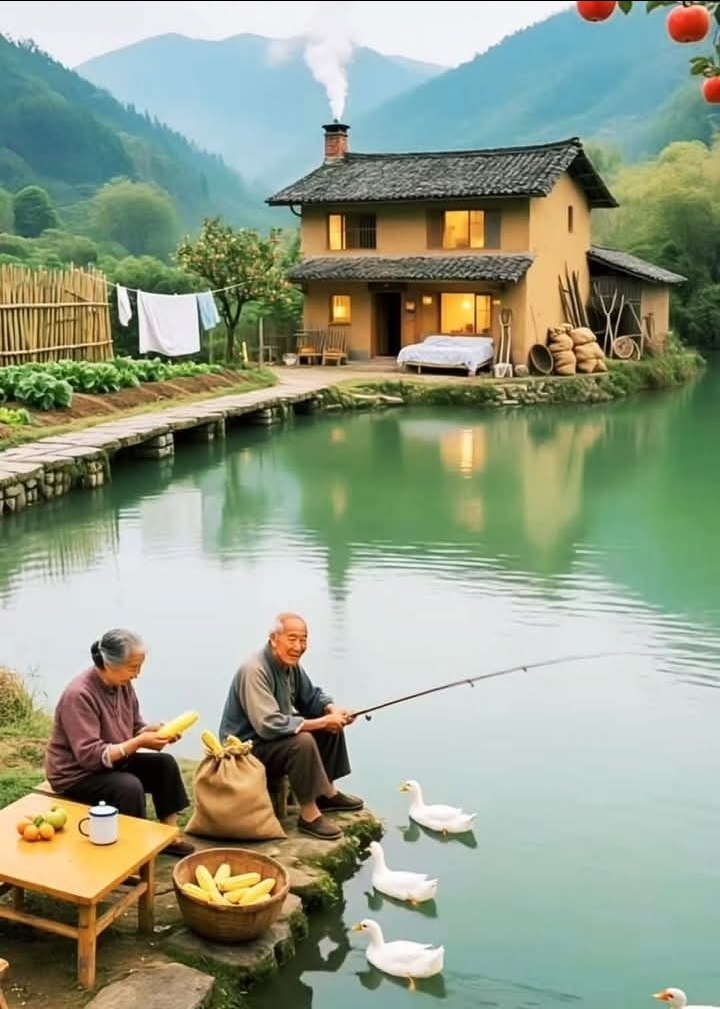
Tucked away at the edge of a quiet village stood a small clay house, shaded by old neem and mango trees. It wasn’t grand, but it was home—a home that echoed with years of laughter, shared meals, and the kind of love that deepens with silence more than with words.
Behind the house stretched a clear pond, its surface mirroring the soft blue sky. On this warm afternoon, after a simple home-cooked lunch, the couple sat side by side under the open sky. He, with his fishing rod steady in hand, eyes on the bobber. She, sitting close, her hands busy cleaning fresh green vegetables in a basket.
White ducks waddled nearby, occasionally dipping their beaks into the water or rustling their wings in the sun. The breeze carried the earthy scent of clay and water, blending with the faint aroma of coriander and mustard oil from their lunch.
“I think this time you might catch a bigger one,” she said, without looking up, a gentle smile on her face.
He chuckled, not taking his eyes off the pond. “And what if I don’t?”
“Then we still have lentils and rice,” she replied, teasingly. “But the fish would make the evening more exciting.”
They both laughed quietly, the kind of laughter that comes from years of shared memories. There was no rush here—no pressure to prove or perform. Just presence. Just peace.
She rinsed the spinach leaves, letting droplets fall back into the steel bowl with a rhythm that matched the ripples in the water. He glanced at her—noticing the silver strands in her hair, the same hands that had once rocked their children to sleep, now preparing dinner like always, calm and steady.
“You remember our first day here?” he asked.
She nodded. “You brought me here as a surprise. I cried. I thought I wouldn’t adjust to the quiet.”
“And now?”
“Now, I can’t imagine noise,” she said softly, meeting his eyes.
A duck quacked as if agreeing, and they both smiled again.
The sun began to dip lower, casting golden reflections on the water. It didn’t matter whether they caught a fish or not. What mattered was this—this moment, this rhythm of life they had chosen together. Simple. Whole. Real.
As she stood to take the vegetables inside, he gently caught her hand. “Wait—look at the light on the water,” he said.
She turned, and they watched together—just a minute more—before life carried them forward again, toward dinner, dusk, and the comfort of their clay house by the pond.
You are not here to stay forever. This world is but a resting place along the way — a temporary shelter for the soul. Like a traveler pausing for a moment’s breath, your time here is brief, and the moment of departure remains a quiet mystery.
Work is a gift, a sacred means to meet your needs and share your light with the world. But even the noblest labor must be balanced with rest. Without pause, your spirit wearies, and the joy that comes from meaningful effort is lost in exhaustion.
Let your words be gentle, your tone kind. Share your thoughts with humility, not insistence. For when we speak too much, we forget how to truly listen — and every soul you meet carries wisdom of its own.
A Story from the Mountains
I once met a man named Elias, an old craftsman who lived in a quiet mountain village. His hands, weathered by years of carving wood, moved with grace and rhythm. People from far and wide came to see his work — intricate, beautiful pieces made not for fame, but out of love.
One winter, I asked him, “How have you kept this up for so long, without burning out?”
He smiled gently and looked out at the snow-covered trees. “I work,” he said, “but I also rest. I walk the forest. I listen to the birds. I make tea for my wife. If I only carve, I forget the song of life. And then, what would I be carving for?”
His words stayed with me. In his quiet, humble way, Elias reminded me that life is not about doing more — it’s about doing what matters with presence.
He never sought praise. When people admired his creations, he would simply say, “It’s the wood that has the story — I just help it speak.”
Wisdom in the Silence
Be present when someone is in need, but step back when gratitude and praise are being passed around. True service is silent, and it seeks no spotlight.
Do not chase after power, riches, or recognition — they shimmer briefly and then fade like mist in the morning sun. Instead, let your heart grow wide with love. Be a quiet friend to those around you. Compassion, more than anything, has the power to heal what seems broken.
When you find a moment of stillness, hold it close. Amid your responsibilities, create space to be alone with your inner self — to listen, reflect, and simply be.
Drop the mask. Let go of who you think you should be, and meet yourself honestly, with tenderness. There is no shame in stumbling. Mistakes do not make you unworthy — they are part of the sacred unfolding.
Remember: no one is born with a wicked heart. Much of what we call evil is simply a soul lost in confusion, groping in the dark. If you carry this truth in your heart, you will become a light for others — not a judge.
Within you lies the same essence found in every awakened being — a pure, luminous awareness untouched by fear or failure. When life knocks you down and shadows cloud your path, do not let despair make a home in you. Instead, take a breath, gather your strength, and keep walking forward.
Faith is the lamp you carry; wisdom is the steady flame it holds. Keep it lit, even in the darkest night. In time, the way will become clear, and you will find peace — not at the journey’s end, but in each step along the way.